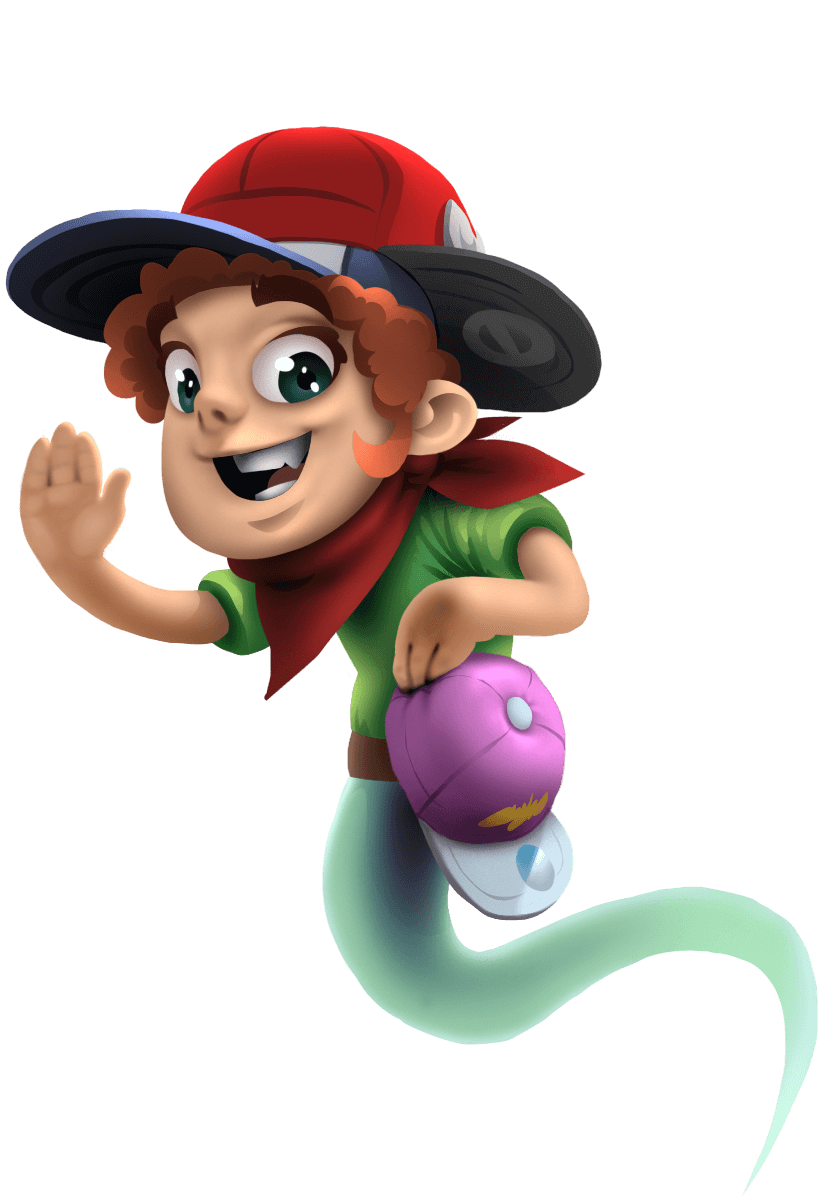



Kaško, the Haravara ghost, has been flying from one window to another for quite some time now
and no, he wasn’t flying because he was washing the windows, nor was he flying because he had mistaken the windows
for a portal to some enchanted land; no, that wasn’t it. He was flying past the windows where his friends, Maxík and Majka, lived.
They were ordinary children, but they had an extraordinary
ability. They could see ghosts.
And so Kaško flew past their windows and watched Majka, who had some pieces of paper on the floor and was wearing a strange short ballet skirt, jumping on those pieces of paper.
Suddenly, Majka jumped on one of the pieces of paper and fell to the ground.
“Owwww,” she yelped like Jánošík the Slovak bandit when he jumped over the bonfire, and she looked into the window, where she saw Kaško’s frightened eyes.
“What are you doing here, Kaško?” Majka asked as she opened the window.
“What would I be doing?” Kaško replied. “I’m watching you to see what you’re doing.”
“I’m training,” Majka replied and continued jumping.
“Oh, for the hurdles,” Kaško mused.
“No way,” Majka jumped onto a blue piece of paper on the ground shaped like a flower.
“What for?” asked Kaško, noticing that the colorful pieces of paper on the ground weren’t just any old scraps, but cut-out colorful flowers.
“And you won’t laugh at me?” Majka looked at the surprised Kaško.
“Why would I laugh at you?” Kaško replied, almost offended, because he never laughed at his friends or made fun of them.
“Because what I’m practicing here right now isn’t normal,” Majka said, lowering her eyes.
“So, you’re training for some kind of weird competition?” Kaško rubbed his hands together curiously, wondering what it could be.
“Oh no,” Majka laughed, cooling Kaško down a bit.
“Well, for a weird… a weird meadow… paper one,” Kaško searched for the words.
“Kaško, I’m training here to become a fairy,” Majka lowered her eyes, as if she had something to be ashamed of.
“What?” Kaško asked excitedly.
“To become a fairy!” Majka repeated, a little more quietly.
“A fairy?” Kaško probed, making sure he understood correctly.
“I don’t know if you know, but every girl in Haravara wants to be a fairy or a teacher,” Majka began to explain.
“Oh, I didn’t know that,” Kaško mused, thinking of all his sisters and cousins.
“Well, now you know,” Majka said, a little bolder now, “and I’m a girl, and I live in Haravara.”
“So, you want to be a fairy,” Kaško summed it up clearly.
“Of course.”
“But why are you walking on paper flowers?” Kaško still didn’t understand.
“Well, if I want to be a fairy, I have to learn to dance on flowers, like a real fairy,” Majka explained.
“Oh!!” Kaško tapped his forehead.
“And until I can stand on a real flower, I’m practicing which flowers I can actually fit on and how to jump from flower to flower,” Majka said and continued her training.
“Smart,” Kaško praised Majka, “but I have something better for you.”
“What?” Majka stopped jumping and stood like a stork fairy on one leg.
“Training with real fairies,” Kaško whispered in her ear, and Majka nearly fainted.
“You know real fairies?” Majka’s eyes widened.
“Of course,” Kaško leaned nonchalantly against the wall.
“And you’ll take me to them?!” Majka begged.
“I’m just waiting for you,” Kaško smiled.
“And where are we going?” Majka was already packing.
„“First to Kysak, then to Sokoľ and Obišovce,” Kaško thought about the route.
“Phew, then we’d better hurry,” Majka said eagerly.
“Indeed, the train to Kysak is leaving Košice in a moment,” said Maxík’s voice; he had been listening to them the whole time from the next room, and when he heard about the trip, he grabbed his backpack and stood in the doorway.
A moment later, they were already sitting on the train, heading for Kysak. They got off the train and climbed the hill, where there were some ruins of an old castle.
“Kaško?!” Majka called out, out of breath.
“Yes,” the fluttering ghost replied cheerfully.
“Where are we?” asked Maxík, now out of breath as well.
“We are, if you please, at the Kysak Castle,” Kaško declared triumphantly.
“Where?” Both children stopped and looked around.
“There used to be a famous castle here in Kysak.”
“Oh, and now?” Maxík teased.
“And now there are these beautiful ruins,” Kaško said, unfazed.
“And what are we doing here?” Majka couldn’t take it anymore; she still hadn’t seen her fairies.
“So, friends, we’re standing in a pretty strange place right now,” the little guy continued.
“We noticed that,” the siblings sat down on the castle stones and took out their snacks.
“We’re standing where three castles meet,” Kaško flew over to them and sniffed the delicious cheese they’d packed.
“And where are the others?” Maxík and Majka looked around.
“Sokoľ Castle is that way, and Obišovce Castle is that way,” Kaško said, swishing his tail like a compass needle.
“And are they all romantic ruins like this?” asked Majka, who was starting to like it here.
“Now you’ve figured it out!” Kaško winked at Majka.
“What?” Majka didn’t get it.
“They used to be guard castles, because Košice was a super city…”
“And it still is,” Maxík said casually between a bite of food and a sip of juice.
“Of course, after all, the capital of Haravara is the capital of European culture,” Majka boasted, showing off her knowledge.
“That too, of course. The castles guarded trade routes and travellers passing through here on their way to markets or to work,” added the ghostly friend, “but when nobody needed these castles anymore, because it was cold in them or they were constantly under attack and dangerous...” Kaško continued to explain.
“That’s when the stone-eaters settled in them,” Maxík added, putting the rest of his snack in his backpack.
“Who?” Kaško didn’t understand.
“Stone-eaters,” Maxík repeated.
“And where did you get that from?” Kaško looked at Maxík in confusion.
“It always surprises me where all the stones from the big castles go when we come across some ruins,” Maxík began to explain seriously.
“Hmm, some stones hid in the ground, under the grass and flowers, because a few years have passed since they fell to the ground. And some ended up scattered across the meadows, and some people took them home to save them from the wind and rain, and now they might be in some houses or fences,” Kaško continued.
“But where are my fairies?” Majka couldn’t take it anymore and even stamped her foot a little.
“Well, right here,” Kaško pointed to the beautiful meadow below the castle.
Majka fell silent and looked around.
“Where here?” she added in a whisper, because she knew fairies didn’t like noise.
“These three castles, as you correctly said,” Kaško lowered his voice, “are romantic ruins.”
“I see,” Majka joined in the quiet voice, “and we know that fairies are romantic creatures.”
“And they like places like this,” Kaško looked around and began to sing a song:
“My dear fairies,
all my strength
is yours alone, believe me,
show yourselves on earth.”
When he finished singing, he looked up, and saw nothing.
He sang it again, and nothing again.
“What’s going on, Kaško?” Majka grew a little nervous.
“Could they have moved?” Kaško wondered.
“Fairies?” Maxík, who wasn’t very fond of fairies, perked up too.
“Fairies never move away, and if they do, it’s not all of them,” Kaško fluttered around, looking for a fairy.
He found one under a tree, flew down to her, and gently woke her up.
“Kaško!?” the fairy opened her eyes, and Majka gasped.
“It really is a fairy,” Majka couldn’t believe it and started pinching her arm and leg to see if she was dreaming.
“Majka, write this down: if you find another place with three castles—like this one—there might be fairies there too, because they love crossroads and meadows between castles,” Kaško explained, watching the fairy wake up. Because fairies need time to wake up.
“What should I look for?” Majka was already writing in her diary.
“A three-castle area—like this one—there are many hiking trails between those castles. If you ever come here with your parents, they’ve just repaired one of the towers at Sokoľ Castle, and it offers a great view of the entire area, and of course you’ll also find well-maintained paths here, marked just as castle and fairy paths should be,” Kaško added.
“And lots of forests and meadows,” chimed in the fairy, now a little more awake.
“And plenty of opportunities to enjoy some great ice cream or just take a stroll. And since the lords of the castles loved walking through meadows and forests teeming with wildlife and enjoyed healing themselves with medicinal flowers, they had all of that right beneath their castles,” Kaško enthused, for he loved fairies.
“This little guy is right,” the fairy whispered.
“And where are your friends?” Majka couldn’t help asking.
“They’re training,” the fairy replied calmly.
“Today must be training day,” Maxík said, clutching his head.
“Exactly,” Kaško chimed in, “first Majka is training to be a fairy, and now the fairies are probably training to be humans.”
“My friends are training so they can become water fairies,” said the fairy, performing her first pirouette on a flower, and Majka couldn’t believe her eyes.
“But, but, why is that?” Kaško asked curiously.
“Well, because we fairies can dance on flowers, but we can’t dance on water or on water flowers,” she didn’t understand why a ghost—who should know better—was asking her this.
“Because you’d get your dresses wet,” Majka mused.
“And some fairies even their wings,” the fairy added.
“Sure, and where do you practice?” Kaško got to the point.
“First we go to Lodina, where we practice kayaking on the Hornád, do a little leg training on the climbing wall, and dance on water lilies,” the fairy’s eyes lit up as she imagined herself dancing on a water lily too.
“Oh,” Majka’s eyes widened, “could I see that?” she added timidly.
“Majka wants to be a fairy, at least for a little while,” Kaško whispered in the fairy’s ear.
“I think that could be arranged,” and the fairy began dancing on the flowers. Kaško wanted to stop her, but Majka stopped him and sketched out the steps fairies make on flowers.
“I’ve got it! I’ve sketched out all the steps for training to become a fairy,” Majka whispered to Kaško. “Now you can,” she said, putting her precious notes back in her purse.
“It would take us a very long time to get there that way. You can get to Lodina by train or bus, but since we want to catch up with the fairies, we have to fly,” Kaško decided.
They arrived at the village of Lodina and found people there climbing a rock wall, rafting, riding e-bikes they could rent there, and some just walking with poles along the hiking trails.
“Are these the fairies?” Majka asked, sounding quite disappointed.
“No, these are people who come to Lodina now to enjoy the ‘Combine Routes, Discover Beauty’ project,” the fairy announced in a soft voice, looking for her sisters.
“What for?” Maxík didn’t understand.
“People can come here and try the climbing wall, rent electric bikes, and go rafting,” the fairy explained.
“So, they choose what they’d like to do today, plan it out nicely, and go for it,” Maxík understood.
“Exactly—they’ll mix and match however they like,” the fairy said happily to the quick-witted human child.
“And where are the fairies?” Majka asked, worried again.
“Up there for now!” the fairy pointed up into the crowns of the magnificent trees that surrounded them.
“And what are they doing up there?” Maxik whispered.
“They’re hanging from the branches like bats to exercise their arms and legs, and when the people leave—which will be in a moment—they’ll get down to it,” the fairy began, nodding to her friends.
“What?” Majka didn’t understand.
“You’ll see,” the fairy winked at Majka.
The sun had dipped a little lower in the sky, and people began to slowly leave. Suddenly, fairies descended from the trees to the ground—there were about 500 of them.
“Goodness, are all of these fairies?” Kaško couldn’t believe it either.
“Of course,” the fairy confirmed and went to greet her fairy sisters.
“Wow,” Majka smiled, and the smile stayed on her face until the next day.
“Sisters,” she addressed the fairies, “our friend Majka, who is a friend of our dear brother Kaško, would like to learn to dance like a fairy.”
The fairies looked her over, and one by one, they slowly reached out their hands to Majka.
“Don’t be afraid, go!” the fairy encouraged Majka.
Majka grabbed the first fairy, who took her to a little boat where she practiced her balance; then she joined the fairies on the climbing wall, who, of course, weren’t actually climbing. The fairies began dancing on the flowers so that their colourful heads spun with the flowers, carrying the fairies all the way to the top of the climbing wall and then back down to the flower. Some of the brave fairies, however, jumped off the flower and grabbed onto the climbing wall, gracefully hopping from one rung to the next. Majka was just trembling, afraid they’d fall down, and she nearly fainted ten times. Luckily, Maxík found a few Nordic walking poles and gave them to Majka so she could lean on them.
“Awesome, I’m the happiest Majka in the world,” Majka shouted with joy, and her voice carried everywhere, perhaps even echoing off our three castles.
“It’s time,” the fairy said suddenly, and the other fairies surrounded Majka.
“What’s going on?!” Majka was a little startled.
“Don’t be afraid, we’re taking you to a place where we fairies have been meeting for thousands of years,” said one of the fairies.
“You must promise us that you won’t reveal this place,” the fairy looked sternly at Majka and Maxík.
“We promise,” they all solemnly promised, while they had to place their fingers on a linden flower, which is sacred to fairies.
The fairies joined hands. The outer circle was formed by fairies with wings, who slowly rose up and flew, but only for a brief moment. They flew to a sort of pond. Right by the pond, there stood a small, unusual little house, around which little animals were running about, and Majka thought that this was where the fairies came to rest.
“Is this where you come to relax?” Kaško asked, because that’s how it seemed to him, too.
“Oh, friends, this is a magical place,” whispered a few fairies.
“Really?” Maxík looked around; to him, too, it seemed like a great spot for a barbecue, not for secret stuff.
“Well, only people come here to relax now, because the nature here is beautiful—Budulovský Pond, which is one of the most beautiful in Haravara, gorgeous flowers grow here, and there are wetlands too,” their fairy friend tried to explain to them.
“And why would you like wetlands?” Majka didn’t understand this, because she had never drawn a fairy in a wetland.
“Well, because we also practice dancing on the water there,” the fairies laughed.
“Oh,” Majka understood and took out her notebook.
“But most importantly, there’s enough water in this pond for the fairies to swim in,” Kaško remembered.
“No way,” even Maxík didn’t believe that anymore; he hadn’t been interested in fairies until now, but spending the whole day with them and hearing all the stories about them had changed his view of them, and he was starting to like the fairies.
“Really. And that’s why, when we used to come here to bathe, soldiers who lived in the area would come down to the water to watch our little dances,” the fairy reminisced.
“And they hunted you,” Maxík let himself get carried away.
“Oh no, they just watched us. And since they knew what you don’t know today—that where fairies thrive, people thrive too—they came here to hunt and even built dwellings like this,” the fairy pointed to a strange but very interesting structure. It looked like a tent connected to an old round chapel that could fit a few people.
“Is that a dwelling?” Maxík asked.
“That’s a yurt,” Kaško explained to Maxík.
“Oh,” Majka whispered, imagining how she would rest in it after dancing with the fairies.
“Old Hungarian warriors used to live in these; they came here to visit us, the fairies.”
Kaško, Majka, and Maxík went to explore the yurt. Inside, they found an exhibition about everything that grows and lives in the area, and Maxík finally had some fun too, because he could try archery there.
And while Maxík and Kaško played Robin Hood and William Tell, Majka went with the fairies to the pond. One of the fairies stretched out her hand, and beautiful flowers peeked out from the ground before them.
“These are yours,” the fairy pointed to the flowers and smiled at Majka.
“Excuse me?” Majka didn’t understand.
“You can dance on these too,” the fairy pointed at the flowers again.
“Oh my,” Majka almost burst into tears.
Then the fairies took Majka, and they danced on the flowers until late in the evening. They showed Majka all the fairy steps—and especially one salamander step, which they’d copied from the salamanders, of which there are countless numbers around these wetlands.
Maxík’s arm had been aching since archery practice, so he and Kaško put away their bows and arrows, took one last look at the beautiful yurt, and took Majka, who didn’t want to go because she wanted to dance with the fairies until nightfall. Only after the fairies promised her she could visit them at the Three Castles—Kysak, Obišovce, or Sokoľ—did she blow a kiss to all the fairies and fly off with Kaško straight to bed. There, she dreamed all night long of dancing on flowers, of teaching her friends how to do it tomorrow, and of how they would watch her every move.